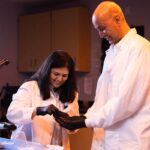
UCF researchers are developing powerful possibilities for industrially aligned research to support advances in healthcare with organ-on-a-chip (OOC) technology.
OOC is built on a miniature glass wafer with human cells that mimics the function of human organs. The chips contain tiny channels lined with living cells, allowing researchers to study how tissues respond to medications, infections or disease in ways that traditional lab methods cannot.
College of Engineering and Computer Science Associate Professor Swaminathan Rajaraman and electrical engineering doctoral student Surbhi Tidke have built on that concept by measuring transepithelial electrical resistance, or TEER — a key indicator of how well cells form protective barriers.
By integrating TEER-on-a-chip, researchers can monitor barrier integrity in real time, offering a noninvasive tool for diagnosing and studying diseases that affect tissues such as those in the lungs, intestines or brain.
Read article from UCF Today.
By Mikita Nayee | October 8, 2025