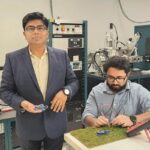
Color isn’t just about looks — it plays a vital role in how we communicate, protect ourselves and interact with the world. Debashis Chanda, a researcher and professor at UCF’s NanoScience Technology Center, has developed a new material that can change color dynamically in response to external stimuli like temperature, which creates a new possibilities for materials and devices to respond, adapt and be reconfigured in real time.
Most colors in commercial and industrial products come from pigments, which absorb, reflect light and fades over time. However, structural colors, which are found in animals like octopuses, use nanoscale structures to control how light reflects. Inspired by this efficient approach, Chanda has been researching how to create more vibrant, angle-independent colors without relying on chemical pigments for years.
His latest development addresses the challenges with dynamically tunable color, complex designs and manufacturing challenges of structural colors, which may make it easier to commercially manufacture these materials. The concept holds immense promise for applications in thermal sensing, advanced textile engineering, camouflage and reconfigurable displays.
The research was recently published in Proceedings of the National Academy of Sciences (PNAS), an esteemed scholarly journal by the National Academy of Sciences. It also includes contributions from researchers Aritra Biswas ’21MS ’24PhD, Pablo Cencillo-Abad, Souptik Mukherjee, Jay Patel ’25 and Mahdi Soudi ’25.
Read article from UCF Today.
By UCF | January 20, 2026